
Understanding Domain-Driven Design
A practical approach to building software around business needs.
What is Domain-Driven Design (DDD)?
Complexity is an enemy that modern software design often has to deal with, even if it can’t be seen. When we design systems for complicated fields like banking, logistics, or healthcare, it’s not enough for the technology to work; it has to speak the same language as the business. This is what Domain-Driven Design (DDD) is all about. Eric Evans came up with it in 2003 and said that the domain model should be at the heart of the development process. We are experts in this field, and we know that DDD is not a strict set of rules. Instead, it is a technique to connect an organization’s strategic goals with technical implementation, turning software from a mere tool into a real competitive advantage.
Strategic Design: Getting to Know the Business
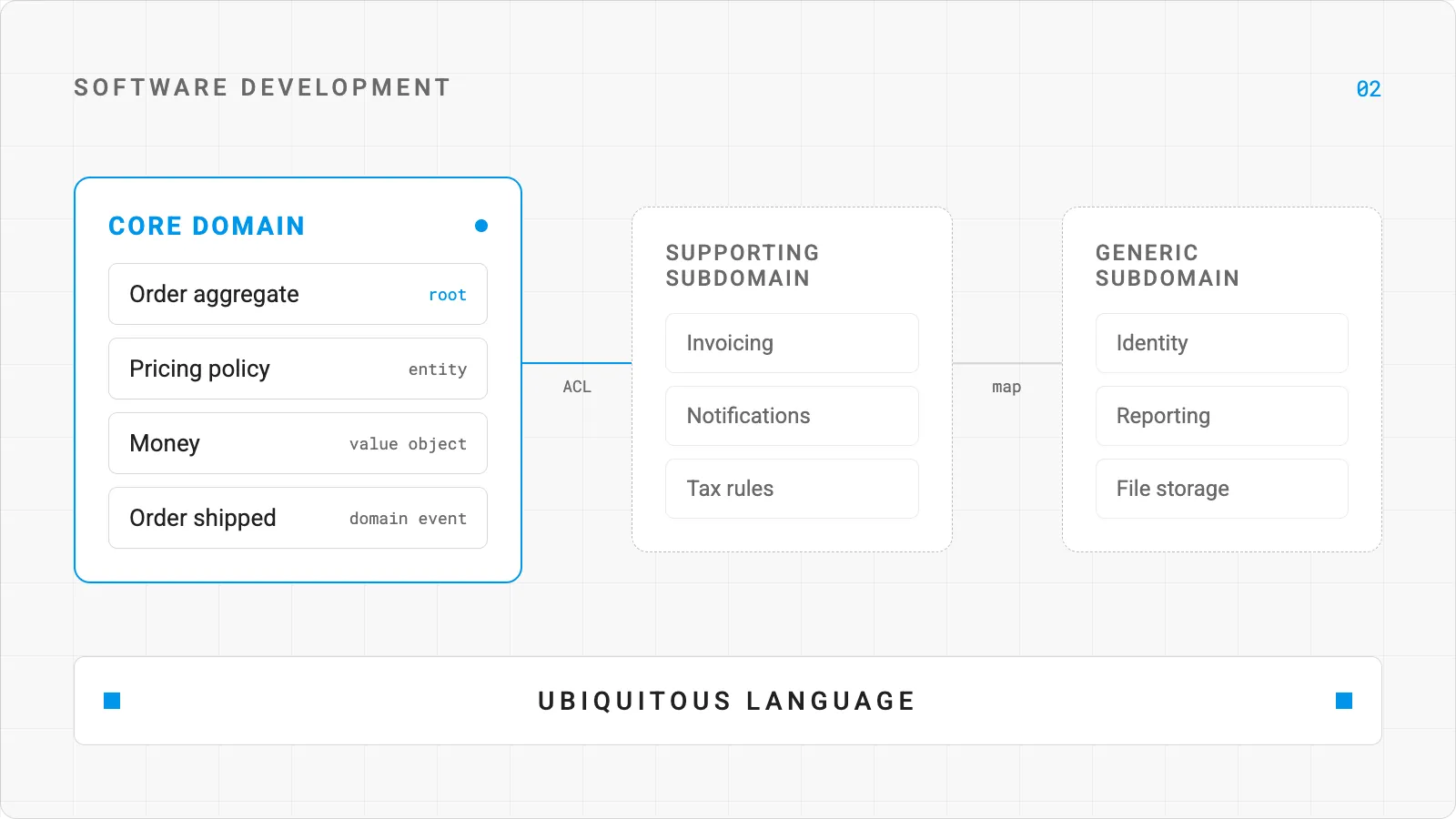
To comprehend DDD, we need to start with its strategic point of view, which helps us divide the big problem down into smaller, more manageable pieces. Strategic Design is the first step. It helps us figure out where the real value of our firm is. DDD enables us to find Subdomains instead of trying to make a single, monolithic model for the whole company, which nearly usually fails. The Core Domain is the strategic center of the business; it’s where innovation and competitive advantage are found. This is where we should put our best people and resources. Not all subdomains are equally important. Supporting Subdomains, for example, offer important but not unique features, while Generic Subdomains show frequent difficulties in the business that can often be remedied with commercial solutions that are already available.
Integration and Bounded Contexts
This breakdown of the problem brings us to one of DDD’s most important ideas: the Bounded Context. In a big system, various people may use the same terminology and ideas in different ways. For example, the sales department and the logistics department do not use the word “order” in the same way. A bounded context sets a semantic limit on where a certain model is valid and consistent. This keeps things clear and lets separate teams grow on their own. The Context Map is what we use to make sure these contexts can work together without causing problems. It shows how they are connected through integration patterns like Shared Kernel, Customer-Supplier, or the important Anti-Corruption Layer, which keeps our model from getting messed up by old or outside systems.
The Language That Is Everywhere
The Ubiquitous Language is what pulls this whole thing together. This is not just a list of words; it is a shared, clear, and strict vocabulary that was established by both domain experts and developers. The code must directly represent the common language: class names, methods, and variables should all utilize the same words that people use in regular business talks. This method does away with the expensive “translation tax” that comes with moving between the technical and commercial worlds. This makes sure that the model accurately reflects business rules and genuine needs.
Tactical Design: Putting the Model into Action
Tactical Design is what we do when we go from strategic design to putting it into action. This is where we locate the pieces that make the model work. Entities and Value Objects are the two most important parts. An Entity is characterized by its unique identity that stays the same over time, even when its properties change. A bank account or a client are good examples because we need to keep track of how they change over time. A Value Object, on the other hand, doesn’t have an identity and is only defined by its properties. They are immutable. If we need to change the value of an address or a money amount, we make a new one instead of changing the one that is already there. Using value objects a lot makes design much easier because it gets rid of unexpected side effects and makes it easy to think about how the system works.
Domain Services and Domain Events
Sometimes, certain business operations don’t naturally belong to a certain entity or value item. We use Domain Services in these situations. These are stateless operations that wrap up logic that involves more than one domain object. They keep our entities clean and stop business logic from getting into the application or infrastructure layers. We use a Domain Event to record something important that happens in the business, on the other hand. These events are immutable records that let different sections of the system talk to each other without having to wait for a response. This makes the system more scalable and allows for eventual consistency across contexts.
Aggregates and Consistency
The Aggregate is without a doubt the most complicated but important tactical pattern. An aggregate is a group of objects (entities and value objects) that are considered as a single entity when data changes, which makes it clear where the boundaries of transactional consistency are. An Aggregate Root is the only way for anything outside of the aggregate to change. The root is like a guard that makes sure all invariants (business rules that must always be true) are met before a transaction can be finished. We suggest making small aggregates to improve performance and simply using the identity (ID) of other aggregates to avoid too much coupling between models, following Vaughn Vernon’s design rules.
Factories and Repositories
DDD gives you Factories and Repositories to help you handle the lifecycle of these complicated objects. Factories make aggregates or entities with complex structures, making sure that things are created in a valid and consistent state from the start. We need a location to store and get to them after they are made, and this is where Repositories come in. A repository is basically a collection in memory that totally hides infrastructure details, such as SQL queries or NoSQL databases. This keeps the domain pure and free of technical concerns.
Architecture and Separation of Concerns
This separation of concerns is important and is made possible by the system design. The purpose is still the same: to keep the domain model separate, whether you choose a classic Layered Architecture that separates the User Interface, Application, Domain, and Infrastructure, or a Hexagonal Architecture that uses Ports and Adapters. In a hexagonal design, the domain is in the middle and is connected to the outside world by ports that don’t depend on any one technology. These ports are made by specialized adapters, like a SQL database, a REST API, or a web interface. This architecture makes sure that the business logic is the most stable and testable aspect of the system because it doesn’t rely on technologies that change all the time.
Changing and Improving Models
Lastly, we need to remember that DDD isn’t something we do only once at the start of a project. Refactoring toward Deeper Insight is an ongoing process. As the team works with domain experts more often, they learn more about the business. We find that some ideas we thought were clear need to be made clear. Breakthroughs, or moments of discovery, often make the model simpler and the design more flexible and powerful. In conclusion, Domain-Driven Design is an invitation to develop software that accurately reflects the business by using strategic and tactical patterns to keep things simple and make sure that every line of code helps the organization succeed and stay strong in the long run.
Final Thoughts
Domain-Driven Design (DDD) is a great way to deal with complexity since it makes sure that software meets the most important needs of the business. Teams may make systems that are both flexible and useful by focusing on strategic boundaries, explicit models, and a shared language. Its tactical patterns make sure that things stay the same and are easy to maintain, while its architectural principles keep the domain safe from outside changes. Most significantly, DDD encourages people to keep learning and working together, which lets models change as the business does. When used correctly, it turns software development into a strategic capability that leads to innovation, clarity, and long-term success.