
Inside Large Language Models
From neural architectures to human alignment, a concise overview of the systems reshaping how people interact with technology.
The Engine of the AI Revolution: An Introduction to Large Language Models
The start of a new era in natural language processing (NLP) has come with the rise of large language models (LLMs). Deep neural networks like the ones that run ChatGPT are built to understand, create, and respond to text in a way that is similar to how people talk to each other. Before they came along, traditional methods did well with simple categorization tasks but had trouble with tasks that required a deeper understanding and the ability to write clear text. An LLM can easily write code, draft emails, or summarize technical articles today.
The word “Large” isn’t random; it refers to the model’s huge size, which often has billions of parameters (the network’s adjustable weights), and to the size of the datasets used to train them, which include trillions of words taken from books, articles, and a lot of the text that is available online. We often say that the model “understands” text, but it’s important to remember that this is not because it is aware of or understands things like a person would. Instead, it is because it processes complex statistical patterns.
The Transformer Architecture: The System’s Heart
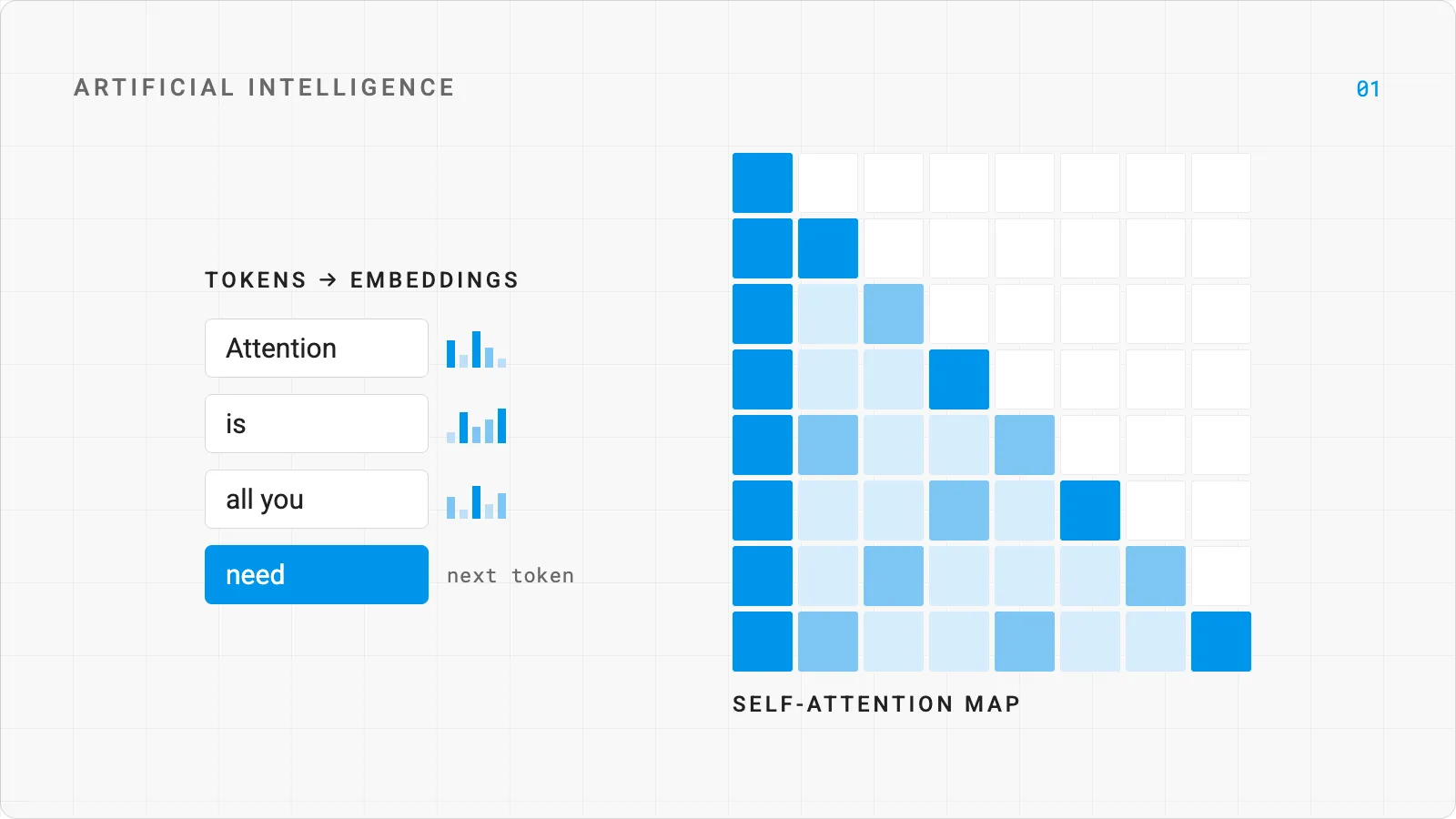
Researchers at Google came up with the Transformer architecture in 2017 in the famous paper “Attention Is All You Need.” This is what makes LLMs work. This architecture took the place of recurrent neural networks (RNNs) because it allows for parallelization, which means that the model can process whole sequences of data at once instead of word by word.
The self-attention mechanism is the most important new thing about the Transformer. This system lets the model “focus” on certain words in a sentence to get the context and long-range dependencies. In the sentence “the teacher and her lesson,” for instance, the attention mechanism helps the model understand that “her” means “teacher.” The model can look at many different parts of language at the same time with multi-head attention, which helps it understand the context better.
Tokenization and Embeddings: From Words to Numbers
To understand human language, a machine must first change text into numbers. The first step in this process is tokenization, which breaks text down into smaller parts called tokens. These can be words, subwords, or even single characters. Every token has its own unique number (ID).
After that, these tokens are turned into embeddings. An embedding is a vector, or list of numbers, that puts each word in a high-dimensional mathematical space that can have anywhere from 512 to 4,096 dimensions. In this space, words that mean the same thing are close to each other. For example, “dog” and “bark” are semantically closer than “dog” and “car.”
The model also gets positional encodings, which tell it where each word is in a sequence, keeping the grammatical order and structure of the sentence.
The Process of Training and Scaling Laws
There are usually two main steps to making an LLM: pretraining and fine-tuning.
The model learns on its own by reading huge amounts of text, like Wikipedia or Common Crawl, during pretraining. The job is easy but important: guess what the next word in a sentence is. This process creates what is often called parametric memory in the model. This is when the network’s weights store information about language and the world.
It takes millions of hours of GPU computation to train these models. This is where scaling laws, like the ones in the Chinchilla paper, come into play. Researchers have found that the best performance happens when there are about 20 training tokens for every model parameter. When a model has too many parameters compared to the data it has, it is over-parameterized and not trained enough.
Fine-Tuning and RLHF: The Human Factor in Alignment
A pretrained model, which is also called a foundation model, can finish sentences, but it may not know how to follow directions or have safe and useful conversations. This is why fine-tuning is used to make the model work for certain tasks, like translation, summarization, or classification.
Reinforcement Learning from Human Feedback (RLHF) is one of the most important ways to make LLMs useful and safe. During this process, human judges look at and rate the model’s different responses based on how good, useful, and safe they are. The information is used to train a reward model, which is then used to improve the main model using algorithms like PPO or DPO.
The end goal is alignment, which means making sure that the AI acts in ways that are in line with what people want and value.
Capabilities, Model Types, and Emergent Abilities
There are three main types of language models based on how they are built:
- Models that only use encoders, like BERT, are great for classifying text and figuring out how people feel about it.
- Models that only use a decoder, like the GPT or Llama family, are best for making text that is autoregressive.
- Encoder-decoder models, like T5, are often used for translation and summarizing text.
The appearance of emergent abilities is one of the most interesting things that has happened in this field. These are abilities that the model wasn’t specifically trained to do, like logical reasoning or translating between low-resource languages. They just happen when the model and dataset get big enough.
Challenges and the Future of Interacting with Machines
LLMs have many great features, but they also have some big problems to deal with. One of the most well-known is hallucination, which is when the model makes up information that isn’t true but seems very sure of itself. This occurs because the model relies on statistical prediction instead of referencing a validated knowledge database.
There are also worries about the ethical biases in the training data used by the internet and the large amount of energy needed to train these models.
To fix these problems, new methods are being created, like Retrieval-Augmented Generation (RAG), which links the model to outside databases to give answers that are up-to-date and can be checked. AI agents are also becoming more common. These are systems that can not only write text but also connect to APIs and do things in the real world, like book flights or handle operational tasks.
In conclusion
Large Language Models are a big change in the way things work. They’ve changed from being interesting things to study in the lab to being an important part of our technology that is changing how we work, learn, and use machines.