
Monolith or Microservices?
A practical look at architecture, scalability, and team autonomy.
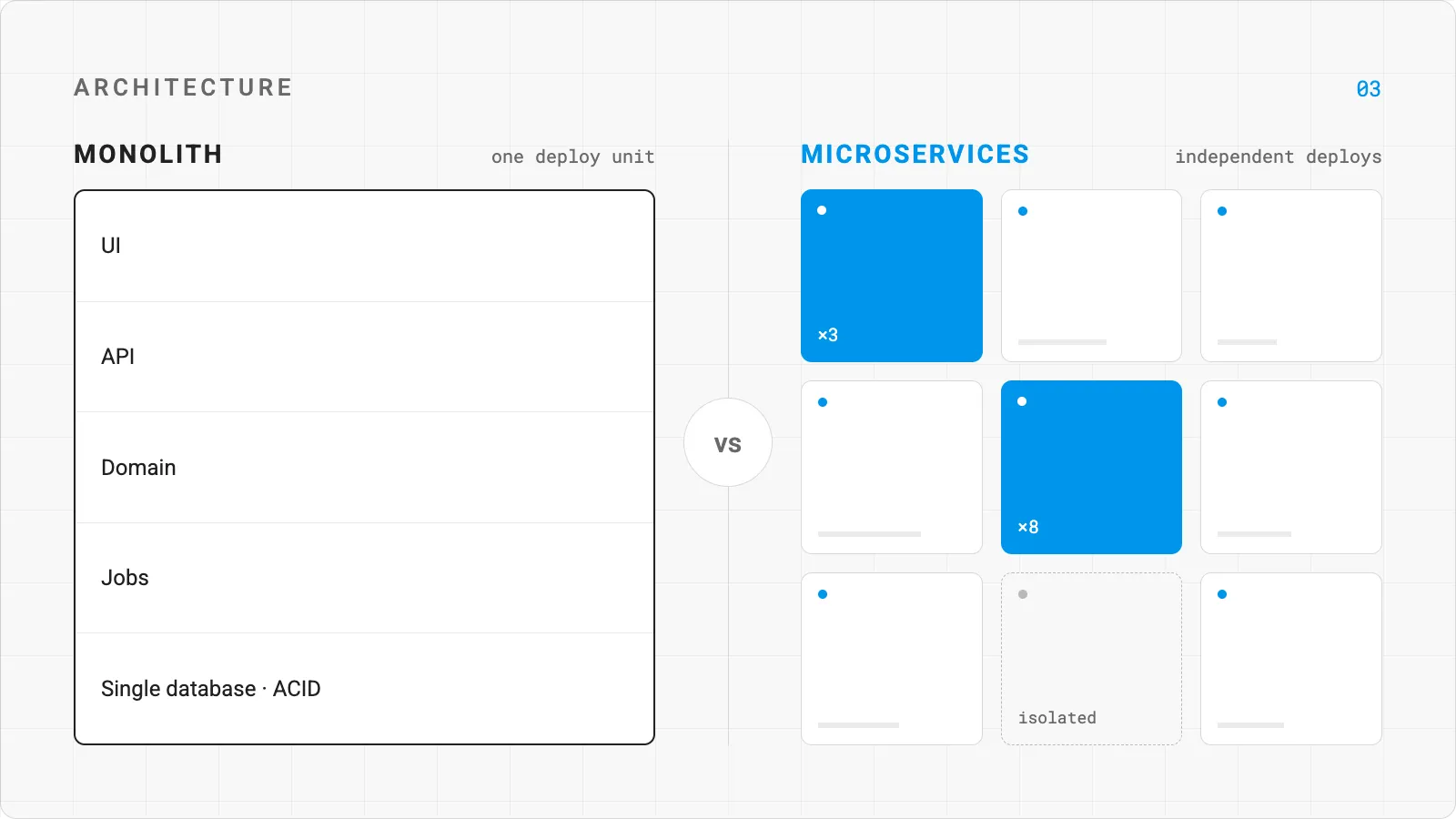
The Evolution of Architecture: The Monolith as the “Sensible Default”
In modern software engineering, the discussion on how to structure applications is often framed as a choice between the old monolith and the new microservices approach. A monolith is a single deployment unit in which all system features must be released at the same time. Even though distributed architectures are becoming more popular, many experts say that the monolith should be the “sensible default” for most first initiatives.
The best thing about this approach is that it’s easy to use: it makes developer workflows lot easier, monitoring is centralized, and end-to-end testing is quite easy. In a monolith, code talks to each other through method calls in the same process. This avoids the latency and serialization problems that networks cause in dispersed systems.
The Problem with Big Complexity: Moving from Monolithic Efficiency to Microservices Freedom
The monolith has frequently been seen as the “sensible default” in software design because it is easy to install and works well at first. In systems where latency is very important, the monolith is better since all communication happens in one process, which saves the expenses of serialization and network traffic that come with distributed systems. Also, managing data is easier because it can use ACID transactions in one database to keep things consistent.
But as a system gets bigger and more complicated, these good points become big problems. When a lot of people are trying to change the same codebase at the same time, they can get in each other’s way. This is called “delivery contention.” At this stage, even a tiny update to a million-line system is very risky and means that the whole application has to be redeployed, which slows down the cycle of innovation by a lot.
This is where microservices show that they are better for complicated systems than other types of services. Microservices are designed around business domains, which makes them easy to deploy on their own. This means that a team can deliver an improvement without having to work with or put the rest of the system at risk. This broken-up architecture works like a bulkhead system: if one service goes down, the problem is contained and the rest of the platform keeps working. This makes it more stable than a monolith can do on its own.
Granular scalability is also a better way to handle increasing complexity. Companies may grow only the services that are getting the most traffic, which saves money and makes better use of cloud resources. Stream-aligned teams help the company grow by making sure that the architecture fits with the organization. This way, technical bureaucracy doesn’t get in the way of productivity.
The “Microservice Premium” and the Problem of Boundaries
When you switch to microservices, you have to pay what is called the “Microservice Premium.” This is the extra work that comes with managing a group of services that might slow down teams if the system isn’t big enough to make it worth it. Also, this design will only work if you can clearly establish stable boundaries between services (bounded contexts). Reworking functionality between services is more harder than reworking it within a monolith. If the boundaries are not clear, a “distributed monolith” forms, which has all the problems of dispersion but none of its benefits. For a lot of companies, where the business world is always changing, this initial rigidity might hurt product development.
The Business Case: Microservices as a Way to Grow
Even with the concerns described above, microservices are the ideal choice for businesses who want to be able to grow and change quickly over time. Microservices architecture is more than simply a technical fix; it’s also a technique to structure a business so that it can come up with new ideas more quickly.
The most important business benefit of microservices is that they may be deployed separately. This lets a team deploy modifications and new features without having to wait for other departments to do the same, which is called “delivery contention.” In marketplaces with a lot of competition, being able to cut down on time-to-market is a very useful skill.
This architecture also makes it possible to scale down to very small levels. A corporation can save money on cloud computing by simply scaling the parts of the program that get the greatest traffic, instead of building infrastructure for the whole thing. A monolith can’t do this. It also has a variety of technologies, which means you can use the best one for each job. This helps attract talent and makes it easier to adapt to new technologies in the future.
Alignment and Resilience in Organizations
One of the best things about microservices is that they fit well with the way a business is set up. Microservices make it possible to establish cross-functional, stream-aligned teams that are fully responsible for a section of the business, following Conway’s Law. This breaks down organizational divisions and encourages a sense of responsibility that boosts productivity.
Failure isolation (the bulkhead pattern) gives the system robustness, so an error in a non-critical element of the system, like the recommendation service, won’t bring down the whole platform. This gentle degradation is what lets big organizations like Philips or Netflix stay up and running all the time while doing thousands of deployments every day.
Conclusion: The Best Strategic Decision
In short, the monolith is the greatest choice for closed systems or early-stage products since it is the most technically efficient and simple. However, microservices are the ideal investment for the future of a contemporary firm.
In a way, adopting microservices is like “buying options.” It’s a bet on an architecture that will expand with the company, allow for ongoing technical progress, and keep the business safe from the problems that come with massive, rigid structures. Microservices are not simply a way to build things; they are the only way for any organization that wants to be big and fast at coming up with new ideas to stay in business and succeed in the digital age.