
Marconn: a scalable IoT platform
Developing a solid foundation to manage smart pedestals in ports and campsites
The challenge
When Marconn, Viltec’s commercial brand, came to us with the project, the situation was demanding from day one. The company, specialized in the development and manufacturing of smart pedestals for ports and campsites, needed a reliable control platform to manage its devices and the associated services. The problem was twofold: the existing software was not scalable as it should, and the timeline was extremely tight.
It was November, and the goal was to reach the following May with around 600 pedestals in production. That meant working with a very clear horizon and very little room for error. This was not just about developing an application, but about building a platform capable of connecting business, operations, and physical devices within a single system.
The challenge included several layers that had to work in coordination: a web application for port and campsite managers, an app for end users, the business logic that had to govern the whole system, and a technological architecture solid enough to scale without compromising operations. In addition, the project included key requirements such as water and electricity service control, usage history tracking, incident management, notifications, and integration between the business API and the IoT layer.
The solution
From the beginning, it was clear to us that, in order to deliver on time and do it properly, we had to prioritize. The best way to tackle the project was to divide it into phases and build a solid foundation before adding more advanced features.
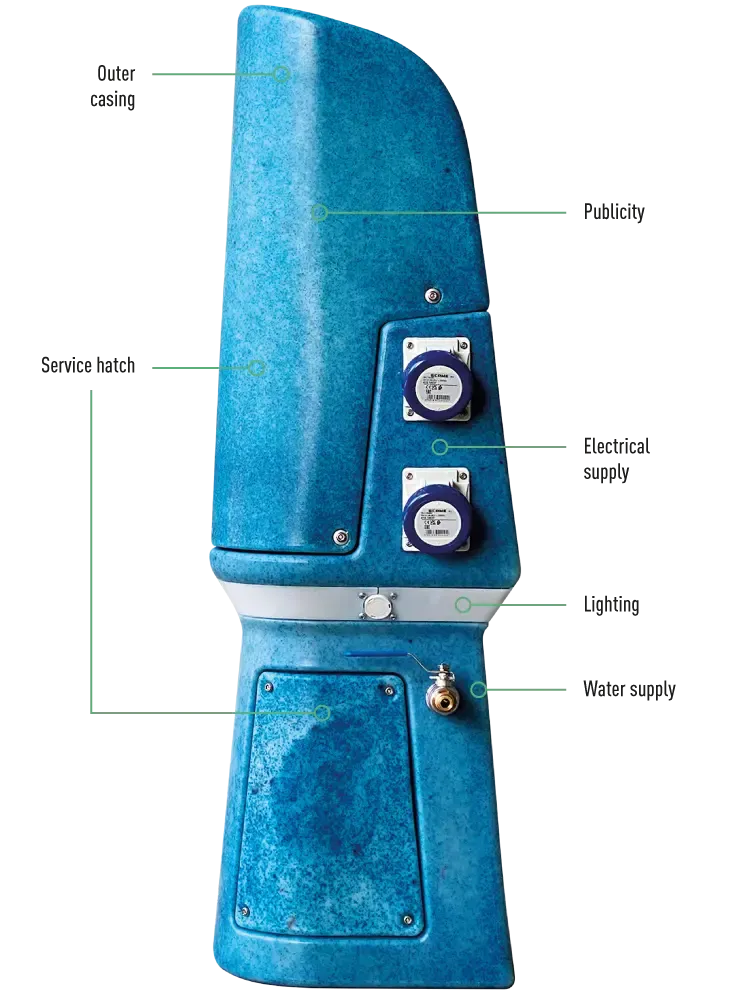
In the first phase, we focused on the core of the system: controlling the pedestals and their main components. This included managing LEDs, water, and electricity, as well as calculating consumption per user account. This part was essential for the platform to accurately reflect what was happening in the field and link each usage event to the corresponding account.
At this stage, one of the most important issues in the project became evident: the existing communication protocol did not provide the scalability guarantees that were needed. As stated in the requirements, it was necessary to modify the original protocol used by the pedestals to communicate with the cloud in order to create a reliable representation of each physical device and ensure that the software could grow in the short and medium term without losing control. This decision was critical, because when a platform must govern thousands of connected devices, scalability stops being a future improvement and becomes an immediate necessity.
In the second phase, we deployed the system’s economic layer: balance top-up, automatic consumption deduction, and the logic required to interrupt service when no credit was available. This responded directly to the goals defined at the beginning of the project, where it was already established that the use of services had to be economically valued, that the sites had to be able to charge for them, and that customers had to be able to purchase credit to use them.
Our aproach
The project was carried out by an agile team of four dedicated people. It may seem like a small team for a challenge of this scale, but that structure gave us a great capacity to react quickly. Everyone had a clear understanding of their role, the final objective, and the actual time constraints. This allowed us to move forward rapidly while always keeping the focus on what mattered most at each stage.
It was also essential to organize the project around a coherent architecture. We did not just need to make the present work, but also to prevent every new feature from becoming a source of fragility. That is why we designed a foundation where business logic was clearly separated from technology and integrations, and where communication between systems could properly respond to a reality based on events, state changes, consumption, and constant notifications.
This approach made perfect sense in an environment like Marconn’s: connected smart devices, physical services that are activated or cut off, incidents that must be logged, and customers expecting a smooth experience both on the web and in the app. The project requirements already pointed in this direction, with a structure made up of a web frontend, mobile applications, a Sites API, and an IoT API responsible for registering devices, maintaining their state, sending actions, and reflecting in the software what is physically happening at each pedestal.
What made the difference
Some projects succeed because of technology. Others succeed because, in addition to technology, there is also a good way of working behind them. In this case, three especially important factors came together.
The first was client involvement. Viltec’s team maintained a collaborative attitude throughout the entire project. Both in moments when everything moved forward smoothly and when doubts or difficulties arose, there was availability, responsiveness, and trust. That trust was decisive in helping us prioritize well, unblock decisions, and keep up the pace of the project without losing alignment.
The second factor was the team. Working with a small, stable team that was highly results-oriented allowed us to move with agility, without coordination overload, and with strong technical consistency.
And the third was flexibility. The requirements were not treated as a rigid checklist, but as a working framework that we had to interpret with sound judgment. We adapted to the available infrastructure, reorganized priorities when necessary, and decided what needed to be solved first in order to maximize the value of each delivery.
The result
The result was not just reaching production on time with a functional platform. The real result was giving Marconn a solid technological foundation on which to continue building.
From the initial launch, the project has been able to incorporate new features and refine existing ones because the original structure was designed with the right criteria. In an environment like this — with connected physical devices, consumption management, and real-world operations in the field — having a robust architecture is not just a technical matter: it is what allows the product to evolve safely without slowing down the business.
This is probably the most important value of the project: not just solving an immediate need, but leaving behind a platform with long-term potential, capable of supporting Marconn’s future growth.